
Your shoulders are up near your ears again. The screen is too close, the inbox won’t slow down, and somewhere between the ninth email and the next meeting, your breath has gone shallow and stuck high in your chest. It’s a pattern most office workers know well, and it’s one the body pays for over time.
Deep breathing exercises offer a straightforward way to interrupt that pattern, calming an overworked nervous system and easing some of the physical tension that builds up in the neck, shoulders, and spine.
What Deep Breathing Actually Does to Your Nervous System
Breathing is one of the few bodily functions you can control directly, which makes it a useful lever for the nervous system. Quick, shallow breaths from the chest tend to signal the sympathetic nervous system, the branch responsible for the fight-or-flight response. Slower, deeper breaths from the diaphragm do the opposite. They activate the vagus nerve, a long cranial nerve running from the brainstem through the chest and abdomen, triggering a parasympathetic response that lowers heart rate and eases muscle tension.
For people asking how to calm your nervous system after a stretch of chronic stress, breath is often the fastest entry point available. A few slow breaths can shift your physiology within a couple of minutes, no equipment or appointment required. Chiropractors who look at the nervous system and spine together often bring breathing into a broader conversation about posture, tension, and how the body holds onto stress over time.
The Benefits of Deep Breathing Exercises for Stress and Anxiety
Regular practice has been linked to a lower resting heart rate, reduced muscle tension, and a steadier response to stressful moments. For anxiety sufferers, breathing exercises for anxiety can serve as a portable tool, something to use at a desk, in traffic, or before a difficult conversation without needing privacy or special equipment.
The benefits tend to build with consistency rather than appearing after a single session. Someone who practises for two or three minutes most days often becomes more aware of tension as it builds, rather than only noticing it once a headache or tight jaw has already set in. That early awareness matters, since catching stress before it compounds makes it easier to manage.
Breathing Techniques Worth Trying
A few different approaches work well, and it’s worth trying more than one to see what suits your body and your schedule.
Diaphragmatic Breathing
Also called belly breathing, this is the foundation most other techniques build on. Sit or lie down, place one hand on your chest and one on your abdomen, and breathe in slowly through your nose so the hand on your stomach rises while the hand on your chest stays relatively still. Exhale slowly through pursed lips. Five minutes before bed or first thing in the morning is often enough to notice a difference in how your shoulders and neck feel.
Box Breathing
This technique uses four equal counts: inhale for four seconds, hold for four, exhale for four, hold for four, then repeat. It’s popular with people who need to reset quickly, since the counting gives the mind something concrete to focus on instead of racing thoughts. Two or three minutes of box breathing before a meeting or after a tense phone call can take the edge off.
The 4-7-8 Pattern
Inhale through the nose for four seconds, hold for seven, and exhale slowly through the mouth for eight. The extended exhale does most of the work here, since a longer out-breath signals the parasympathetic nervous system more strongly than a longer in-breath. This pattern is often used to wind down before sleep, though some people find the extended hold uncomfortable at first and prefer to start with shorter counts.
Why Posture and Breathing Are Connected to Spinal Health
Breathing mechanics and spinal alignment influence each other more than most people realise. A hunched, forward posture, the kind that builds up after hours at a desk, compresses the chest cavity and makes it harder for the diaphragm to move freely. This often pushes people toward shallow, chest-based breathing without them noticing, keeping the nervous system in a slightly more activated state throughout the day.
Restoring better movement through the mid-back and rib cage can make diaphragmatic breathing easier to access. This is part of why breathwork and chiropractic care tend to complement each other. A spine that moves freely through the thoracic and lumbar region supports fuller, deeper breaths, and deeper breaths in turn support a calmer nervous system, one that isn’t holding tension in the neck and shoulders by default.
When Breathing Exercises Aren’t Enough
Deep breathing exercises are a useful, low-risk habit for most people, but they aren’t a substitute for professional care. If breathlessness, dizziness, or a racing heart show up outside of moments you’d expect, during rest rather than after exercise or stress, this needs to be assessed by a health professional before you continue any breathing practice. People managing panic disorder or a diagnosed anxiety condition should also check with their treating psychologist or doctor about which techniques suit their situation, since certain breath-holding patterns can occasionally intensify symptoms.
Chiropractic care can support the physical side of this picture, including posture, spinal mobility, and how freely the rib cage moves, but it works best alongside appropriate mental health support when anxiety is a significant or ongoing concern, not instead of it.
Deep Breathing Exercises: Your Questions Answered
| Question | Answer |
|---|---|
| What are the benefits of deep breathing exercises? | Deep breathing exercises can lower resting heart rate, ease muscle tension, and support a calmer response to stress. Regular practice, even a few minutes a day, tends to build awareness of tension before it turns into a headache or tight jaw, making stress easier to manage as it builds rather than after it peaks. |
| How does deep breathing affect the nervous system? | Slow, diaphragmatic breathing activates the vagus nerve, which triggers the parasympathetic nervous system and lowers heart rate and muscle tension. Quick, shallow chest breathing tends to do the opposite, keeping the sympathetic fight-or-flight response switched on longer than necessary. |
| What is the best breathing technique for anxiety? | There isn’t one technique that suits everyone. Diaphragmatic breathing, box breathing, and the 4-7-8 pattern are all commonly used breathing exercises for anxiety, and most people benefit from trying a few to see which feels manageable and fits into their day. |
| Can breathing exercises help with neck or back tension? | Breathing exercises alone won’t correct spinal alignment, but improving how you breathe can ease some of the muscle tension that builds around the neck, shoulders, and upper back. Pairing breathwork with chiropractic care that addresses posture and spinal mobility often supports better results than either approach alone. |
| How often should I practise deep breathing exercises? | A few minutes most days tends to be more useful than one long session occasionally. Many people find it easiest to attach the habit to something already in their routine, such as before bed, during a commute, or ahead of a stressful meeting. |
| When should I see a professional instead of relying on breathing exercises alone? | If you experience breathlessness, dizziness, or a racing heart outside of exercise or stress, see a GP before continuing any breathing practice. People with panic disorder or a diagnosed anxiety condition should also check with their treating psychologist or doctor about which techniques are appropriate. |

Final Thoughts
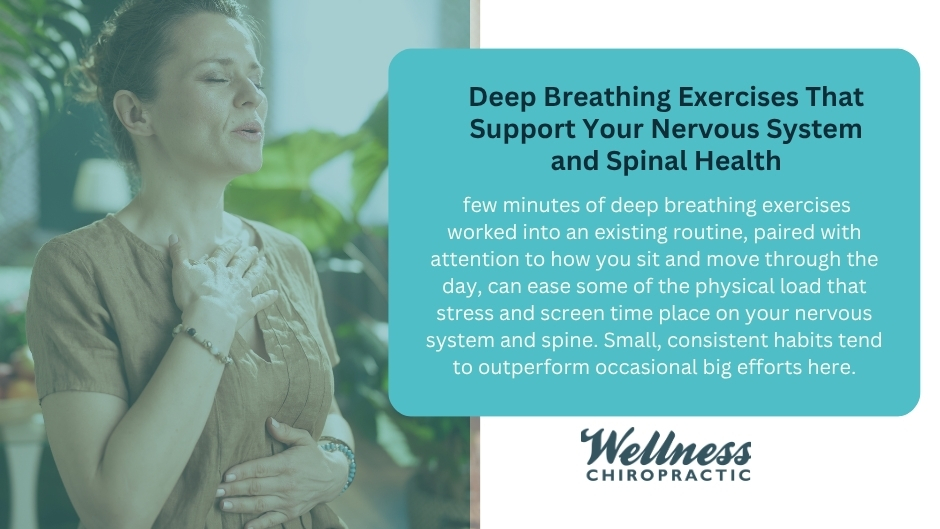
None of this requires a major lifestyle overhaul. A few minutes of deep breathing exercises worked into an existing routine, paired with attention to how you sit and move through the day, can ease some of the physical load that stress and screen time place on your nervous system and spine. Small, consistent habits tend to outperform occasional big efforts here.
If tight shoulders, neck tension, or ongoing stress are showing up in your body, book an appointment at Wellness Chiropractic in Prahran.
Our team can assess how your posture and spinal mobility are affecting your breathing and put together a plan that supports both.